
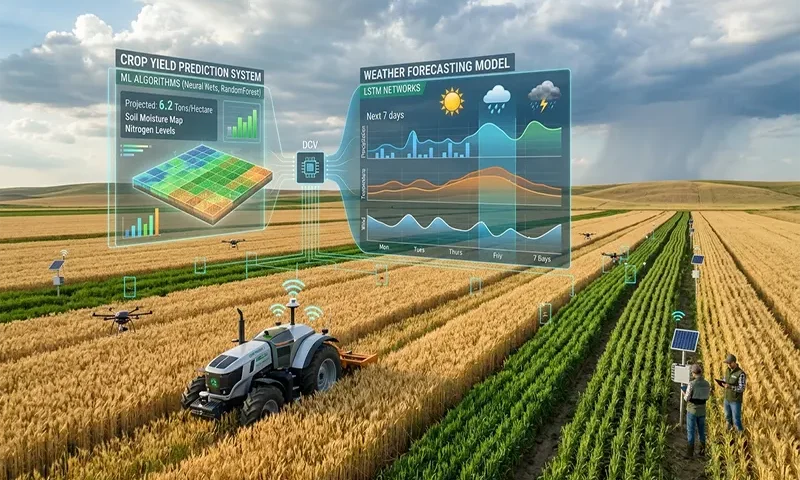
Extreme weather volatility directly threatens global food security and agribusiness profitability. As climate shifts disrupt historical baselines, traditional agricultural models—which rely heavily on static regional averages and historical look-back tables—increasingly fail to provide accurate guidance.
Modern precision agriculture addresses this challenge by deploying machine learning (ML) architectures. Instead of relying on broad generalizations, ML processes multi-dimensional, hyper-local data streams. This approach handles two distinct but deeply connected tasks: modeling complex atmospheric dynamics to forecast local weather conditions, and decoding biological responses to predict plant growth and crop yields.
Algorithmic Engines for Weather Forecasting
Traditional Numerical Weather Prediction (NWP) models rely on physics equations to simulate fluid dynamics and thermodynamic changes in the atmosphere. While highly structured, NWP models are computationally expensive and struggle with localized, short-term forecasting. Machine learning approaches bypass these physics-heavy simulations by treating weather forecasting as a data-driven, spatio-temporal modeling challenge.
Sequential Deep Learning: LSTMs and GRUs
Meteorological observations are inherently sequential. To process time-series data from weather stations—such as barometric pressure, relative humidity, wind velocity, and ambient temperature—deep learning architectures leverage Long Short-Term Memory (LSTM) networks and Gated Recurrent Units (GRUs).
LSTMs use specialized memory cells and gating mechanisms (input, forget, and output gates) to preserve long-term dependencies across time steps. This prevents the vanishing gradient problem common in standard recurrent architectures, allowing the model to capture subtle climatic cycles that signal severe weather events days before they occur.
Spatial-Temporal Evolution: Transformers and GNNs
Modern atmospheric modeling goes beyond single-station time series by analyzing spatial relationships across entire regions. Precision agriculture increasingly uses Graph Neural Networks (GNNs), where localized weather sensors act as nodes and physical terrain features represent edges.
Additionally, Transformer-based architectures utilize self-attention mechanisms to map complex cross-regional weather patterns simultaneously. By calculating how an atmospheric front in one county influences the microclimate of a specific farm hours later, these systems deliver predictive accuracy at a fraction of the computational footprint required by traditional supercomputer-driven NWP models.
Machine Learning for Crop Yield Prediction
Crop yield prediction requires ingesting heterogeneous datasets. A predictive model must evaluate structural soil properties, management inputs (fertilizer applications, seeding densities), atmospheric conditions, and real-time plant physiology.
[ Remote Sensing (NDVI/LAI) ] ──┐
[ Tabular Soil & Weather ] ─────┼──► [ XGBoost / Random Forest ] ──► [ Yield Prediction ($R^2$/$RMSE$) ]
[ Historical Yield Data ] ──────┘
Tabular Tree-Based Ensembles: XGBoost and LightGBM
For tabular agricultural data containing historical yield records, soil pH levels, cation-exchange capacity, and weather metrics, tree-based ensemble models consistently deliver top-tier performance. Random Forests construct numerous independent decision trees to reduce variance through bagging.
For maximum precision, Extreme Gradient Boosting (XGBoost) and LightGBM build trees sequentially, where each new tree minimizes the residual errors of its predecessor. These gradient-boosting algorithms natively handle missing data arrays, map non-linear relationships, and provide clear feature importance outputs, allowing agronomists to identify which environmental variables most heavily influence final harvest volume.
Spatial Remote Sensing: Convolutional Neural Networks (CNNs)
To evaluate crop status mid-season, models process high-resolution satellite and drone imagery. Convolutional Neural Networks (CNNs) use spatial convolution filters to extract visual features from multi-spectral images.
By analyzing pixel-level variances across specific light wavelengths—such as the Near-Infrared (NIR) and Red Edge bands—CNNs compute critical biological metrics like the Normalized Difference Vegetation Index (NDVI) and Leaf Area Index (LAI). The network translates these visual patterns into quantitative biomass estimates, mapping field variations to predict field-wide yield outcomes.
Core Algorithm Matrix
| Algorithm Profile | Core Structural Strength | Primary AgTech Application | Evaluation Metrics |
| LSTM / GRU | Captures long-term temporal dependencies in time-series data | Hyper-local precipitation and temperature forecasting | $RMSE$, Mean Absolute Error ($MAE$) |
| XGBoost / LightGBM | Highly efficient regression on heterogeneous tabular datasets | Ingesting soil, weather, and fertilizer records for yield estimation | Coefficient of Determination ($R^2$), $RMSE$ |
| CNN (e.g., ResNet) | Extracts spatial features and textures from multi-channel images | Processing satellite/drone imagery to track crop vigor and canopy cover | Mean Squared Error ($MSE$), $R^2$ |
Integration Layer: Coupling Weather and Yield Models
The true value of precision agriculture emerges when weather forecasting and crop yield prediction models operate within a single, unified data pipeline.
[ Trained Weather Model (LSTM) ] ──► [ Simulated Forecast Ensembles ]
│
▼
[ Target Yield Model (XGBoost) ] ◄──────────────────┘
│
▼
[ Risk Analytics & Yield Adjustments ]
In this coupled architecture, the output of the temporal weather forecasting engine serves as a dynamic input feature for the crop yield regression model. Throughout the growing season, the system runs Monte Carlo simulations across hundreds of forecasted weather paths.
For instance, if the LSTM weather model projects a 70% probability of a late-summer heatwave alongside a deficit in topsoil moisture, this simulated scenario is passed directly into the trained XGBoost yield model. The engine then simulates how the heat stress will affect plant development during critical growth phases (such as silk emergence in corn or pod-filling in soybeans), allowing farm enterprises to adapt irrigation schedules, apply protectants, or hedge their financial positions on commodity markets weeks in advance.
Engineering Challenges and Data Realities
Deploying machine learning models in production agriculture presents distinct engineering challenges:
- Feature Engineering Demands: Raw data points like daily high and low temperatures are insufficient for biological models. Data pipelines must calculate derived agronomic features, such as Growing Degree Days (GDD)—the cumulative heat units required for a plant to mature—and real-time crop water stress indices.
- Spatial and Temporal Gaps: Public satellite data streams (e.g., Sentinel or Landsat) face data gaps due to persistent cloud cover, while rural areas often lack high-density weather station coverage. Engineers address these gaps using interpolation techniques and synthetic data generation.
- The Explainability Bottleneck: Deep learning architectures like GNNs or deep CNNs function as “black boxes.” When a model predicts a 15% drop in crop yield, growers need to know why to take effective action. Integrating SHAP (SHapley Additive exPlanations) frameworks helps make complex model predictions transparent and actionable for field agronomists.
- Shifting Climate Baselines: As global weather volatility increases, historical training data becomes a less reliable indicator of future trends. Models must be built with continuous retraining pipelines and data-weighting strategies that prioritize recent localized anomalies over long-term historical means.
Combining machine learning weather forecasting with automated crop yield prediction provides a data-driven foundation for resilient, climate-smart agriculture. By leveraging LSTMs to track complex atmospheric patterns alongside tree-based ensembles and CNNs that model biological growth, precision agriculture moves away from historical guesswork. This integration enables predictive efficiency, helping the global agricultural industry optimize resources, manage environmental risks, and maximize crop yields in a changing climate.

