
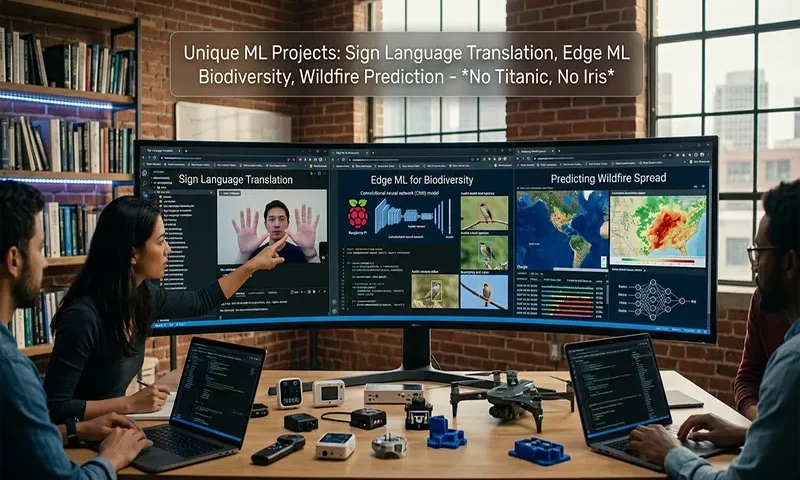
Unique Machine Learning Project Ideas That Aren’t Titanic or Iris

Technical recruiters and machine learning engineering managers are facing severe portfolio saturation. When evaluating candidates, they regularly sift through resumes featuring identical, academic exercises: predicting survival rates on the Titanic, classifying Iris flower species, or parsing digits from the MNIST dataset. While these datasets are excellent for learning basic syntax, they rely on clean, pre-processed data that fails to reflect the messy realities of production engineering.

To stand out in a competitive market, your portfolio must feature unique, non-trivial projects that solve unstructured data problems, involve real-world data engineering, and demonstrate a clear path to production. The three enterprise-grade project blueprints below showcase your ability to handle complex data structures and modern machine learning paradigms.

Project 1: Graph Neural Networks (GNNs) for E-Commerce Anti-Fraud & Sybil Detection

The Concept

Traditional fraud detection models evaluate transactions row-by-row using tabular classifiers like XGBoost. While effective for isolated incidents, this approach misses coordinated … Read More

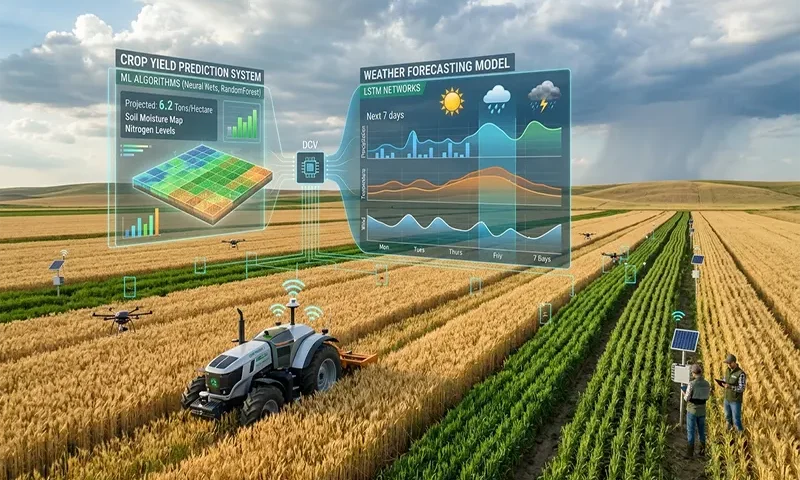
Machine Learning Algorithms for Crop Yield Prediction and Weather Forecasting

Extreme weather volatility directly threatens global food security and agribusiness profitability. As climate shifts disrupt historical baselines, traditional agricultural models—which rely heavily on static regional averages and historical look-back tables—increasingly fail to provide accurate guidance.

Modern precision agriculture addresses this challenge by deploying machine learning (ML) architectures. Instead of relying on broad generalizations, ML processes multi-dimensional, hyper-local data streams. This approach handles two distinct but deeply connected tasks: modeling complex atmospheric dynamics to forecast local weather conditions, and decoding biological responses to predict plant growth and crop yields.

Algorithmic Engines for Weather Forecasting

Traditional Numerical Weather Prediction (NWP) models rely on physics equations to simulate fluid dynamics and thermodynamic changes in the atmosphere. While highly structured, NWP models are computationally expensive and struggle with localized, short-term forecasting. Machine learning approaches bypass these physics-heavy simulations by treating weather forecasting as a data-driven, spatio-temporal modeling challenge.

Sequential Deep Learning: LSTMs and GRUs

Read More
Complex Full-Stack Software Engineering Projects to Build for Senior Roles

When interviewing for Senior, Staff, or Principal Engineer positions, traditional full-stack portfolios fall short. Engineering directors and technical architects are not evaluating your ability to construct clean user interfaces or map standard REST endpoints to relational databases. They are looking at how your systems manage distributed state, mitigate network latency, ensure data consistency under heavy mutation, and gracefully degrade during infrastructure failures.

To prove senior-level competency, a portfolio project must showcase your ability to design distributed systems. It should explicitly demonstrate your mastery of the trade-offs outlined by the CAP theorem, concurrency control, and high-throughput data engineering.

Project 1: Real-Time Collaborative Document Editing Engine

Building an enterprise-grade collaborative editing canvas (similar to Figma or Google Docs) demonstrates a deep understanding of real-time state synchronization across distributed clients. The core challenge is solving concurrent conflict resolution without relying on a centralized database lock that would destroy the user experience.

[ Client … Read More

Beginner Computer Vision Projects Using Python and OpenCV

Computer vision is one of the most dynamic subfields of computer science, driving innovations from autonomous vehicles to augmented reality. At the center of this revolution is OpenCV (Open Source Computer Vision Library), an open-source framework optimized for real-time computational throughput.

Many beginners believe that computer vision requires training massive, resource-heavy deep learning models. However, classical image processing—manipulating pixel matrices, color spaces, and geometric transformations—is computationally efficient and highly effective. These three interactive projects will take you from working with static images to processing real-time webcam data streams using Python and OpenCV.

Project 1: Automated Document Scanner & Perspective Correction

The Concept

When you photograph a document or a receipt at an angle, the perspective becomes skewed. This project recreates the core engine of mobile document-scanning apps. The program takes a skewed image, isolates the edges of the document, finds its four corners, and applies a perspective warp to yield … Read More