
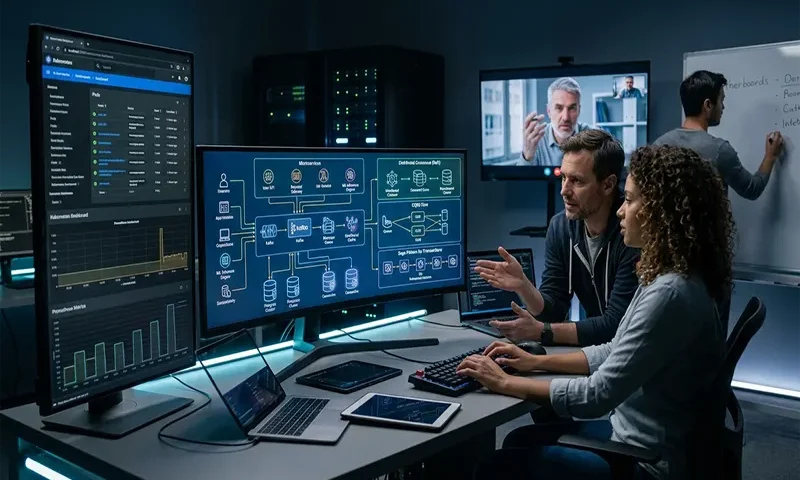
When interviewing for Senior, Staff, or Principal Engineer positions, traditional full-stack portfolios fall short. Engineering directors and technical architects are not evaluating your ability to construct clean user interfaces or map standard REST endpoints to relational databases. They are looking at how your systems manage distributed state, mitigate network latency, ensure data consistency under heavy mutation, and gracefully degrade during infrastructure failures.
To prove senior-level competency, a portfolio project must showcase your ability to design distributed systems. It should explicitly demonstrate your mastery of the trade-offs outlined by the CAP theorem, concurrency control, and high-throughput data engineering.
Project 1: Real-Time Collaborative Document Editing Engine
Building an enterprise-grade collaborative editing canvas (similar to Figma or Google Docs) demonstrates a deep understanding of real-time state synchronization across distributed clients. The core challenge is solving concurrent conflict resolution without relying on a centralized database lock that would destroy the user experience.
[ Client A (React + Yjs) ] ──(WebSockets)──► [ Elixir/Phoenix Node 1 ] ──┐
▲ │
│ (Redis Pub/Sub) ├──► [ CRDT State Engine ]
▼ │
[ Client B (React + Yjs) ] ──(WebSockets)──► [ Elixir/Phoenix Node 2 ] ──┘
Architectural Complexities
- Conflict Resolution Mechanics: Implement Conflict-free Replicated Data Types (CRDTs) using libraries like Yjs or Automerge, or design an Operational Transformation (OT) engine. You must demonstrate how mutations are merged deterministically across offline and online clients.
- Stateful Connection Scale: Design a horizontally scalable WebSocket infrastructure using an ecosystem like Elixir/Phoenix or Node.js with Redis Pub/Sub to broadcast operations across multi-node clusters.
- Memory Management: Because keeping entire documents in server memory introduces leakage risks, you must implement a strategy to flush transient state down to a persistent store (e.g., PostgreSQL or a NoSQL document store) during periods of user inactivity.
Front-End Engineering Challenges
The user interface must decouple its rendering loops from network latency. You need to implement optimistic UI updates, manage complex cursor-tracking coordinates over fluctuating networks, and build a custom synchronization layer that handles local event buffering when a user goes offline.
Project 2: High-Throughput Financial Ledger & Event Sourcing Engine
Designing a double-entry accounting ledger capable of processing thousands of financial transactions per second presents a classic data systems problem: guaranteeing mathematical immutability and absolute consistency across a distributed microservices architecture.
Architectural Complexities
- Event Sourcing & CQRS: Instead of storing the current state of an account balance, store the raw, unchangeable stream of financial events using Apache Kafka or an immutable ledger store. Use Command Query Responsibility Segregation (CQRS) to build read-optimized views of account balances into a separate relational database.
- Concurrency Control: To prevent overdrafts and double-spending across distributed nodes, implement an optimistic locking strategy or deploy a distributed locking mechanism using a tool like Redis (Redlock) or a strictly configured Zookeeper ensemble.
- Idempotency and Relational Integrity: Enforce idempotency keys at the API gateway layer to safely drop duplicate requests from network retries. Ensure your ledger engine maintains perfect mathematical alignment, meaning the sum of all debits must equal the sum of all credits across any transactional boundary.
Front-End Engineering Challenges
The client application must handle complex state reconciliation. It should implement resilient request-retry state machines with exponential backoff algorithms natively in the UI, and cleanly render highly interactive, high-density financial reconciliation ledgers that stream updates via Server-Sent Events (SSE).
Project 3: Dynamic Distributed Video Transcoding & Adaptive Streaming Pipeline
This project focuses on processing intensive, compute-bound workloads. You will construct an automated video ingestion and processing system (similar to a localized YouTube infrastructure) that handles multi-gigabyte uploads, manages high-CPU transcoding workers, and optimizes media distribution.
[ Client Upload ] ──► [ API Gateway ] ──► [ S3 Object Storage ]
│
(Triggers Event)
▼
[ HLS/DASH Streaming ] ◄── [ Cloudflare CDN ] ◄── [ Distributed Transcoding Workers (FFmpeg) ]
Architectural Complexities
- Chunk-Based Parallel Processing: Large media assets cannot be processed as single files without blocking worker queues. Your orchestration layer must slice incoming video files into uniform temporal fragments, distribute those chunks across a parallel fleet of auto-scaling workers running FFmpeg, and stitch them back together upon completion.
- Queue Strategy and Resource Throttling: Manage CPU-bound task distribution using message brokers like RabbitMQ or Celery. Implement dead-letter queues (DLQs), dynamic worker auto-scaling profiles, and backpressure mitigation strategies to prevent cluster crashes when ingestion volume spikes.
- Storage and Content Delivery: Design object storage lifecycle policies to transition raw files to cold storage, while generating HLS (HTTP Live Streaming) or DASH manifests structured into varying adaptive bitrates for global distribution through a Content Delivery Network (CDN).
Front-End Engineering Challenges
On the client-side, skip standard HTML5 video tags. Implement a lower-level player engine using frameworks like video.js or native Media Source Extensions (MSE). The application must analyze real-time network telemetry to adjust streaming quality smoothly without stuttering or dropping frames.
The Production Checklist for Senior Portfolios
To convince engineering leadership that you can operate at a Staff or Senior level, your repository must go beyond application code. It needs to reflect real-world operational readiness.
- Observability & Distributed Tracing: Wire your microservices with OpenTelemetry to emit structured metrics, logs, and trace spans. A reviewer should be able to spin up your project alongside a Grafana/Jaeger stack and trace an API request across every architectural layer.
- Automated Failure Injection: Document how your system handles a split-brain scenario or a database partition. Code and include automated integration tests that simulate network dropouts, container restarts, and cache invalidation storms.
- Load Infrastructure and Benchmarking: Do not guess your system’s limits. Use load-testing frameworks like K6 or Locust to push your platform to its breaking point. Document your system’s performance limits directly in your project’s README.md using clean Markdown tables:
| Concurrent Users | Requests Per Second (RPS) | P99 Latency | System Bottleneck Location |
| 1,000 | 4,200 | 42ms | None (CPU Stable at 35%) |
| 5,000 | 18,500 | 110ms | Redis Network I/O Bandwidth Limit |
| 10,000 | 22,100 | 1,450ms | PostgreSQL Connection Pool Exhaustion |
Senior software engineering is ultimately about managing architectural trade-offs. There is rarely a single “correct” tool or pattern. When presenting your system, the most valuable asset you can share is the design rationale behind your decisions. Document why you chose eventual consistency over strong consistency for certain modules, why a relational database outperformed a NoSQL key-value store for your ledger layout, and how you minimized costs while scaling. Building and explaining these complex systems demonstrates that you are ready to design and lead production architectures.

