
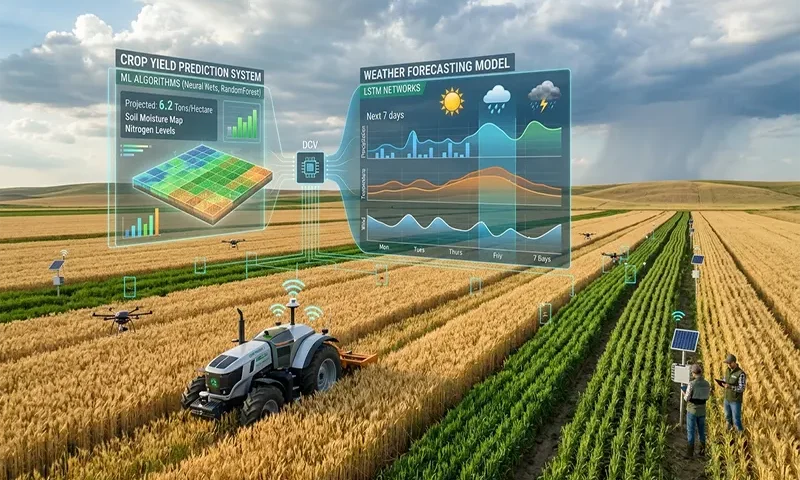
Machine Learning Algorithms for Crop Yield Prediction and Weather Forecasting
Extreme weather volatility directly threatens global food security and agribusiness profitability. As climate shifts disrupt historical baselines, traditional agricultural models—which rely heavily on static regional averages and historical look-back tables—increasingly fail to provide accurate guidance.
Modern precision agriculture addresses this challenge by deploying machine learning (ML) architectures. Instead of relying on broad generalizations, ML processes multi-dimensional, hyper-local data streams. This approach handles two distinct but deeply connected tasks: modeling complex atmospheric dynamics to forecast local weather conditions, and decoding biological responses to predict plant growth and crop yields.
Algorithmic Engines for Weather Forecasting
Traditional Numerical Weather Prediction (NWP) models rely on physics equations to simulate fluid dynamics and thermodynamic changes in the atmosphere. While highly structured, NWP models are computationally expensive and struggle with localized, short-term forecasting. Machine learning approaches bypass these physics-heavy simulations by treating weather forecasting as a data-driven, spatio-temporal modeling challenge.
Sequential Deep Learning: LSTMs and GRUs
… Read More