
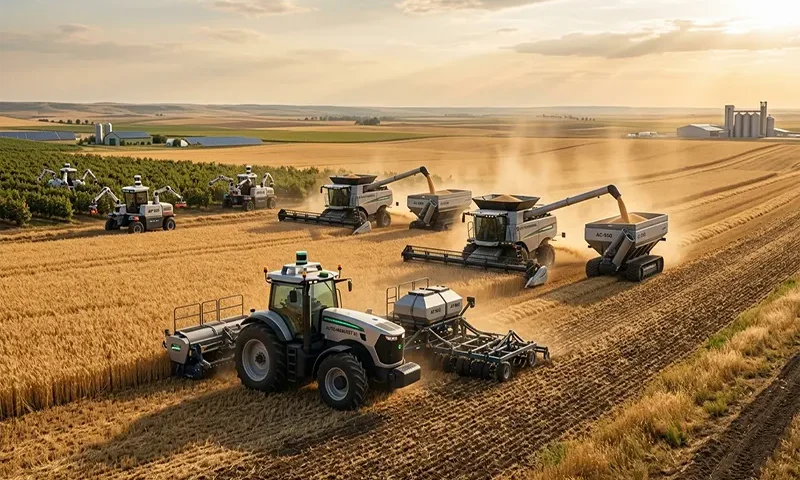
Large-scale commercial farming operates on Razor-thin margins and incredibly compressed seasonal timelines. In recent years, these pressures have been severely compounded by chronic agricultural labor shortages and unpredictable global weather patterns. When a crop reaches peak readiness, a delay of even 48 hours due to a missing equipment operator can result in millions of dollars in spoiled yield.
To combat these bottlenecks, the agricultural sector is undergoing a profound shift away from human-dependent operations toward autonomous fleet orchestration. By integrating artificial intelligence, robotics, and advanced machine vision, heavy machinery can now operate continuously, maximizing input efficiency and maintaining tight operational windows without a driver ever stepping into a cab.
Top Autonomous Tractors Redefining Broad-Acre Farming
The backbone of primary field operations—deep tillage, broad-acre planting, and air seeding—is being fundamentally transformed by high-horsepower autonomous tractors capable of unmanned, 24-hour runtime.
John Deere 8R/8RX Autonomous Tractors
John Deere represents the vanguard of fully autonomous row-crop production. The high-horsepower John Deere 8R and 8RX (four-track) series deliver up to 540 horsepower (and up to 634 maximum horsepower via Intelligent Power Management) to handle massive, heavy-draft implements.
The driverless configuration does away with manual steering entirely, relying on a sophisticated 12-camera stereo vision array that feeds real-time visual data into onboard deep neural networks. The system computes spatial mapping at millisecond intervals, automatically categorizing obstacles, livestock, or humans. If a field anomaly is detected, the machine halts instantly and pings the fleet operator’s mobile device. Operators deploy and monitor the tractor entirely through the John Deere Operations Center mobile app, establishing precise geofenced boundaries before launching a mission.
Monarch Tractor MK V
While John Deere dominates broad-acre row crops, the Monarch MK V redefines utility and specialty farming, such as viticulture and orchards. The MK V is a completely electric, driver-optional autonomous platform delivering 70 peak horsepower.
The tractor features a smart roof equipped with 360-degree cameras and 3D sensor suites. Because it is fully electric, the MK V operates with near-total silence, eliminating the deafening roar of traditional diesel engines. Beyond autonomous mowing and disking, the MK V serves as a data-collection node, constantly scanning crop rows to estimate yield trends and flag localized plant stress. Additionally, its swappable 80 kWh lithium-ion battery system can double as a remote power exporter, acting as a rolling generator to power farm tools in remote fields.
Advanced AI Harvesting Robots for High-Value Crops
While tilling and spraying follow deterministic paths, harvesting requires a much higher degree of cognitive complexity. A harvesting robot must analyze highly irregular environments, detect object orientation, determine maturity, and execute delicate structural manipulation.
Advanced Fruit and Berry Picking Robotics
For delicate, labor-intensive specialty crops, companies like Advanced Farm Technologies and Organifarms have engineered automated harvesters that protect fruit integrity. These machines utilize advanced computer vision models trained on millions of object-classification profiles to evaluate fruit maturity based on color chromatography and physical shape.
Once a target berry or fruit is identified, the robot commands a highly articulable robotic arm tipped with custom, food-safe silicone grippers. By utilizing precise force-torque sensors, the machine detaches the fruit without bruising the flesh, matching or exceeding the speed of manual labor lines while operating through the night.
Raven Industries OMNiDRIVE
In broad-acre grain operations, harvesting efficiency relies on seamless logistics between the combine harvester cutting the crop and the tractor hauling the grain cart. Raven OMNiDRIVE™ resolves this logistical friction by automating the support tractor.
[ Combine Harvester ] ──(Radio Sync)──► [ Driverless OMNiDRIVE Tractor ]
│ │
(Auger Deploys) (Aligns under Auger)
│ │
└───► [ Secure Grain Transfer On-the-Go ] ◄────┘
Using a tablet interface inside the combine cab, a single operator can call the autonomous OMNiDRIVE tractor-cart fleet to drive alongside the moving combine. The system utilizes local radio-based synchronization to match the combine’s speed and direction perfectly, allowing the combine to offload grain safely on the go without stopping. Once full, the autonomous tractor receives a command to shuttle back to a designated staging area to unload, eliminating grain spillage and saving hundreds of manual labor hours.
Equipment Architecture Comparison
| Machine Platform | Power Source | Primary Function | Core AI Tech Stack |
| John Deere 8R/8RX | Diesel (JD14 13.6L Engine) | Heavy tillage, large planters, air seeding | 12-camera stereo vision, StarFire guidance, Geofencing neural nets |
| Monarch MK V | Electric (80 kWh Swappable Battery) | Orchard/Vineyard maintenance, mowing, data scouting | 360-degree smart roof cameras, Edge-AI feature tracking, 10 kW Power Export |
| Raven OMNiDRIVE | Interfaced Aftermarket Diesel Fleet | Coordinated grain cart transport and harvest support | Localized radio-frequency synchronization, AI-driven predictive path mapping |
The Core AI Tech Stack Under the Hood
The safe deployment of unmanned heavy equipment requires an interconnected hardware and software ecosystem. Autonomous agriculture relies heavily on Real-Time Kinematic (RTK) GPS navigation. While standard consumer GPS features an error margin of several meters, RTK systems cross-reference orbital satellite signals with localized, fixed ground base stations, reducing spatial positioning errors to a sub-inch margin ($<2.5\text{ cm}$).
This precision navigation is reinforced by multi-layered perception technology. Deep learning models, specifically variants of Convolutional Neural Networks (CNNs), are embedded directly into edge-computing hardware on the tractor. This allows the machine to run localized, low-latency inference, processing inputs from LiDAR arrays, radar sensors, and optical cameras simultaneously. This sensor fusion creates a redundant safety barrier, ensuring the machine can navigate through thick field dust, blinding midday glare, and total darkness.
Operational Challenges and ROI for Mega-Farms
Despite the clear efficiency gains, deploying fully autonomous fleets involves significant operational hurdles:
- High Initial Capital Expenditure (CapEx): Outfitting a commercial farm with cutting-edge autonomous machinery or advanced aftermarket retrofits demands a steep upfront investment that can stretch farm amortization schedules.
- Connectivity Bottlenecks: Cloud-backed fleet management and real-time mapping dashboards require reliable, high-bandwidth rural wireless connectivity. In remote fields with poor cellular coverage, operators must deploy dedicated private mesh networks or satellite internet receivers.
- Regulatory Compliance: Localized legislation regarding unmanned heavy machinery varies widely. Agricultural operations must navigate complex liability and compliance frameworks when running completely driverless equipment close to public roadways or shared rural boundaries.
However, for enterprise-scale operations, the Return on Investment (ROI) is highly compelling. By reducing chemical and seed overlapping via sub-inch steering precision, optimizing fuel consumption through AI-driven path planning, and unlocking continuous 24-hour harvesting windows, large-scale operations typically realize full cost amortization within 24 to 36 months.
Autonomous fleet integration is rapidly transitioning from an experimental luxury to a fundamental operational necessity. As commercial farming contends with an aging workforce and volatile weather cycles, AI-powered tractors and harvesting robots provide the predictability required to secure the global food supply chain. The future of farming belongs to operators who manage algorithms and orchestrate fleets from a dashboard, turning precision data into maximized field yields.

