
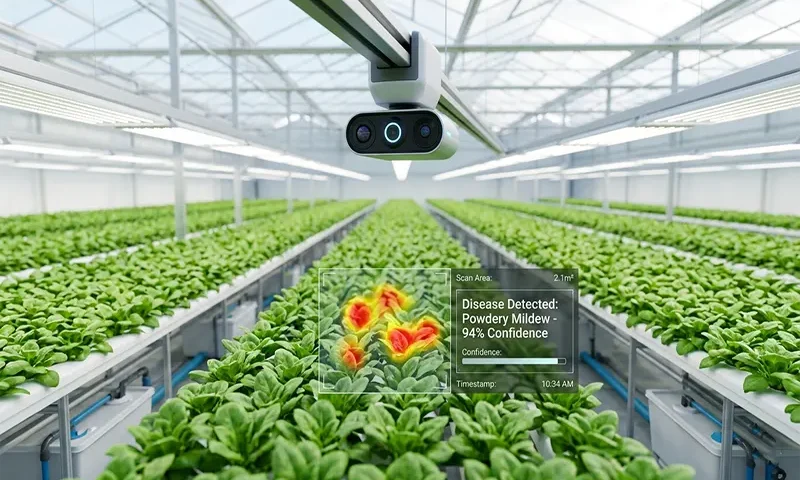
The global agricultural sector faces a staggering challenge: up to 40% of global crop yields are lost to pests and plant diseases annually, costing the global economy over $220 billion. For generations, combating these threats meant reactive firefighting—blanketing entire fields in chemical pesticides after an outbreak had already taken hold.
However, a shift is underway. Artificial Intelligence (AI) is transitioning modern farming from a reactive struggle to predictive, precision agriculture. By transforming raw visual and environmental data into actionable insights, AI allows growers to detect, identify, and manage crop threats before they can devastate a harvest.
How AI Detects Pests and Diseases
Modern AI doesn’t just automate tasks; it observes, learns, and predicts. To manage crop health, AI frameworks primarily rely on two core technologies: Computer Vision and Predictive Analytics.
Computer Vision: The Digital Agronomist
At the heart of visual AI detection are Convolutional Neural Networks (CNNs) and real-time deep learning architectures like YOLOv5. These models function similarly to a human eye but process data at an incomparable scale. When a camera captures an image of a leaf, the AI analyzes it frame-by-frame, extracting features like edge deformities, microscopic textures, and subtle coloration changes.
The system can immediately differentiate between a harmless nutritional deficiency, a fungal pathogen like late blight, or a localized pest infestation such as the brown planthopper.
Multimodal Imaging and Satellites
AI’s sight is not limited to standard smartphone cameras. Integrated with drones and orbital satellites, AI processes multi-spectral and hyperspectral imagery. These specialized sensors capture wavelengths of light outside the visible spectrum, such as near-infrared.
Because stressed plants reflect light differently than healthy ones, geospatial platforms can flag a disease hotspot in a massive field days before the human eye can spot a single yellowing leaf.
Predictive Analytics: Stopping Outbreaks Before They Begin
AI is equally adept at processing non-visual data. By synthesizing real-time Internet of Things (IoT) soil sensors, hyper-local weather patterns, and regional historical data, AI algorithms can predict pest migrations and pathogen development. If a certain threshold of humidity and temperature is reached, the AI alerts the farmer that conditions are ripe for an outbreak, allowing for targeted preventative measures.
A Step-by-Step Guide to Implementing AI on the Farm
Transitioning to AI-driven crop management does not require an advanced degree in data science. Modern software is built for field utility. Growers can integrate these tools into their daily routines through a structured approach.
Step 1: Select the Right Tool for Your Scale
The choice of technology depends heavily on the size and nature of the agricultural operation:
- For Smallholders and Specialty Growers: Mobile-first applications are highly accessible. Apps like Plantix (often called a mobile hospital for plants), Agrio, and PlantVillage Nuru utilize a smartphone’s built-in camera to provide rapid diagnostic support.
- For Large-Scale Enterprise Farms: Broad-acre operations benefit from enterprise agtech platforms like Taranis, AgroScout, or FlyPix AI. These systems aggregate sub-millimeter drone photography and satellite data into comprehensive dashboards.
Step 2: Establish an Optimization Protocol
AI models depend entirely on high-quality input. To maximize accuracy, scouting protocols should follow standard technical guidelines:
- The “Golden Hour” Scanning Rule: Avoid capturing diagnostic photos in direct, blinding midday sunlight, which washes out leaf textures. Early morning or late afternoon light yields the highest contrast.
- The Clean Background Check: When capturing a symptomatic leaf via a mobile app, place a neutral surface (like your hand or a clipboard) behind it to isolate the specimen from background weeds and soil noise.
- The Zig-Zag Scouting Pattern: When deploying drones or walking fields for manual imaging, utilize a systematic zig-zag pattern across the acreage to ensure representative data sampling rather than checking only the easily accessible field edges.
Step 3: Execute Targeted, Prescriptive Treatment
Once the AI provides a diagnosis, it delivers precise, localized recommendations. Rather than blanket-spraying an entire 100-acre field because a single corner shows signs of armyworms, operators can use the AI’s geospatial coordinates to apply treatment strictly to the affected zone. Advanced operations can export these prescription maps directly to smart, automated sprayers or autonomous drones for autonomous spot-treatment.
[ Field Camera / Drone / Satellite ]
│
▼
[ AI Computer Vision Model ] ──► (Analyzes leaf textures & spectral data)
│
▼
[ Real-Time Alert & Diagnosis ] ──► (Identifies specific pest or pathogen)
│
▼
[ Variable-Rate Spot Application ] ──► (Applies treatment only where needed)
The Tangible Benefits of AI-Driven Protection
Adopting artificial intelligence in crop protection yields significant financial and environmental advantages.
- Substantial Input Cost Savings: By shifting from uniform chemical applications to variable-rate spot spraying, farmers frequently see a 20% to 25% reduction in pesticide and fungicide expenditures.
- Yield Recovery: Early detection minimizes the spread of aggressive diseases. Catching an infection during the vegetative phase, rather than the generative phase, recovers an average of 10% to 15% of crop yields that would otherwise be lost to severe damage.
- Environmental Stewardship: Lower chemical volumes reduce pesticide runoff into local water tables, protecting non-target beneficial insects, preserving soil biology, and supporting biodiversity.
- Labor Efficiency: Instead of spending hours manually walking miles of crop rows searching for symptoms, farm managers can review automated AI dashboard alerts, deploying labor exclusively to verified hotspots.
Current Challenges and the Horizon of Smart Farming
Despite its clear utility, the widespread adoption of AI in agriculture faces a few remaining hurdles. Rural internet connectivity remains a limiting factor for heavy cloud-based data processing, though developers are increasingly mitigating this by deploying lightweight, offline-capable AI models directly onto mobile devices and edge hardware. Furthermore, advanced drone and satellite systems require upfront capital investments that can challenge smaller operations, though open-source public options are bridging the gap.
Looking ahead, the integration of AI with autonomous machinery is accelerating. We are seeing the steady adoption of autonomous weeding robots and smart retrofitted sprayers—such as Greeneye Technology—which use real-time computer vision to detect individual weeds and shoot a micro-dose of herbicide at millimeter precision while moving at standard field speeds.
Artificial intelligence is turning the tide against the crop diseases and pests that threaten global food security. By transforming data into a proactive shield, AI empowers modern growers to work more efficiently, cut input costs, and protect their yields. Implementing these tools is no longer a futuristic concept—it is an accessible, sustainable business strategy for the modern farm.

